
Anyone who learns Chinese inevitably gets a lot of well-intentioned advice thrown their way. I dug into my memory and picked out the very worst advice on learning Chinese in this blog article.
1. Read books for children – something easy like Harry Potter
“There is no such thing as a child’s book that only children can enjoy.”
— C.S. Lewis
A persistent misconception remains the idea that if you’re new to Chinese, it’s best to start with “easy children’s books”. For example, “The Little Prince,” “Harry Potter,” or “The Chronicles of Narnia,” to name just a few frequently recommended titles. But also the typical children’s books you can find in any Chinese children’s bookstore with pinyin above the characters and cute pictures. Stories about bunnies who don’t listen to their mothers and pigs who eat too much chocolate.

The problem is already becoming apparent. Books like Harry Potter aren’t as simple as some people think. I recently picked up “The Philosopher’s Stone” from the bookshelf again, and the language isn’t simple at all. Moreover, it features numerous names that are also very unusual or invented by Ms. Rowling. In Chinese, that’s almost impossible to make heads or tails of. The same can be said about reading Game of Thrones in Chinese: lots of difficult names and idioms.
Chinese children’s books – well, they’re really for children. Papa panda takes his little ones to the bathhouse. Peppa Pig likes to jump in muddy puddles. That’s of no use to the average learner.
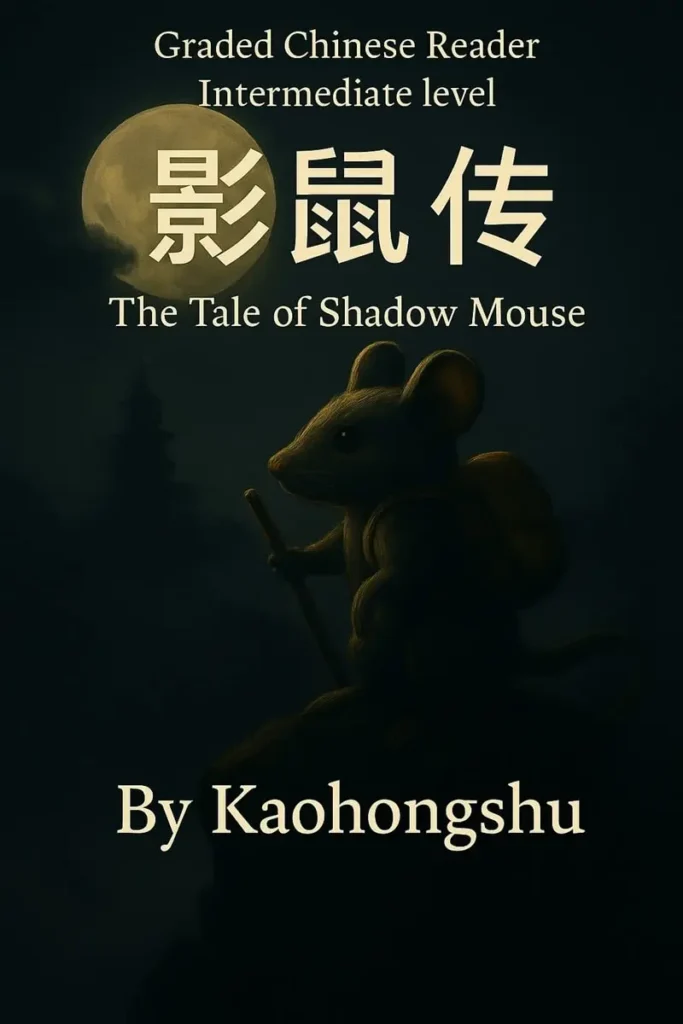
So what does? Reading at your level, or even below it. That’s what helps. John DeFrancis’s classic Chinese reader for beginners lets you read Chinese text step by step – from words to sentences and short texts. All of it builds on each other. And, of course, graded readers like Shadow Mouse, which – hopefully – are easier and more fun to read than the dull texts in your Chinese textbook.
2. Read your textbook lessons as fast as you can
“Practice doesn’t make perfect. Practice makes permanent.”
— Henry Roediger
When I learned Mandarin at a Chinese university, we had to read with a stopwatch. The teacher would set a time – for example, one minute. We had to rattle off a typical class text – a long block of text introducing about 40 new words – from “Developing Chinese” in under a minute. The effect was that you were mainly focused on reading out each character as quickly as possible, without worrying about the pronunciation and tones – or what you were reading. One classmate even managed to read the text aloud at a breakneck pace, but it sounded like he was reading in his own language, his words weren’t recognizable as Chinese.
I must say, this forced you to practice a lot, and that did have an effect. However, this kind of textbook learning takes its time. So first listening, then repeating the words. I would dutifully write the correct tones above (new) characters. Listen again, repeat. Then read it myself. Perhaps even record myself and listen back. Unfortunately, without paying attention to pronunciation, tones, and intonation, it’s all pointless. Speed doesn’t matter if nobody understands what you’re saying. That makes things more tedious, but in my experience this is the only thing that works.
3. Spend more time studying – Study once a month for seven hours straight
“We are what we repeatedly do. Excellence, then, is not an act, but a habit.”
— Will Durant
Everyone gets hit by a sudden burst of motivation now and then. You might grab your notepad and start writing down those HSK words, each with a nice example sentence. Or you might do 300 flashcards in a day.
There’s nothing wrong with that in itself. Especially if you enjoy it. The trick, of course, is not to maintain that pace, but at least to learn daily. So, pace your study time, so to speak, so your brain is engaged with the language every day. If you’re taking Chinese lessons, this (usually) comes almost automatically. If you’re learning independently, this can be more challenging. But consistency is key. (Check “The neuroscience of effectively self-studying Chinese” for more about this).
4. Write down every new character at least 30 times
“Repetition without understanding is futile.”
— Confucius
This is one of my favorite tips I got from my teachers back in the day. Here’s a new chapter from the book, 40 new words. Write each one down thirty times to memorize them for the dictation.
Now, you’re probably right to wonder what’s wrong with that (it’s only 1200 characters), or how should you do it? My biggest objection is the assumption that if your hand makes the same movement often enough, each character will flow naturally. I followed this advice back then, filled entire notebooks with writing, and didn’t notice a thing. So, is it really worthwhile to spend so much time on writing? Aren’t there better methods for writing Chinese?

Yes, one method, or rather, an app, is Skritter. It was developed to help learners better understand and practice Chinese characters. Much more enjoyable and productive. Furthermore, it’s also a matter of being blessed with teachers who are skilled enough to explain the components of a character and certain relationships.
5. First learn vocabulary – focus on tones later
“Pronunciation is not just a cosmetic detail; it is the foundation of intelligibility.”
— Joan Morley
Dryly drilling Chinese vocabulary without paying attention to correct pronunciation is a bit like making an elaborate oven dish without salt and pepper. Or like trying to drive a car without steering. Just like that car, your communication shoots off in all directions, and that’s not much use to you, let alone to the people trying their best to follow you.
When learning vocabulary, you therefore need to pay attention to the whole package and let your tongue and mouth perform that Chinese acrobatics. Don’t think that proper articulation is something that will come later. No, you’re much better off going all in from the very beginning. Like a darts player who throws their darts every day to stay in shape: daily practice works best.
6. Never review anything you’ve learned
“Learning is not a spectator sport.”
— D. Blocher
It’s no wonder that people often struggle with reviewing what they’ve learned. I myself still unconsciously associate this with ploughing through and summarising hard-to-decipher notes in preparation for exams. Rather than flipping back, most people prefer to look ahead and learn new things. Many language teachers also want to keep things light and avoid putting too much pressure on learners.
Yet experience shows that regularly looking back at what you’ve already done is a highly effective way to improve your language proficiency. The real difficulty lies in actually doing it. Even just 20 minutes of review once a week can already make an enormous difference.
7. Always trust the first dictionary definition you see
“A dictionary is a guide, not a judge.”
— Samuel Johnson
Using a Chinese dictionary is a science in itself. Apps like Pleco or Hanping make things easier, but even then you can’t blindly trust that an online dictionary will understand what you’re looking for. Pinyin alone often won’t get you very far either. An entry like “xiang” already produces more than twenty definitions. If you don’t also know the character and the tone, choosing the right one becomes difficult, especially when you’re just starting out.
This is where being able to write characters suddenly becomes incredibly useful again, for example with the help of Skritter. AI tools also offer many possibilities, not only for explaining a word, but also for coming up with example sentences or generating practice material.
8. Pick a new app every week and restart your learning from scratch
“If you chase two rabbits, you will lose them both.”
— Russian proverb
While it is absolutely worth trying out different apps and thinking carefully about your budget – how much money you’re willing to spend on apps, books, lessons, and so on – it’s also advisable to draw your conclusions after a testing phase. You may grow tired of certain apps or outgrow them as your learning progresses, but in the end you shouldn’t throw the baby out with the bathwater. Above all, keep the apps that genuinely help you and align with your goals.
It’s also perfectly fine to spend some money on this. If you’re investing your hard-earned cash, you naturally want to get as much value in return as possible. I’m writing this because I know how many apps for learning Chinese exist by now – or rather, I don’t actually know, but there are an awful lot of them. If you know what goal you want to achieve, however, you only need a few. Here, “less is more” and “more is less” both apply: more apps mean more distraction and less learning progress. So stick with what truly works for you.
9. Stick to HSK-vocabulary lists only, never learn words that real people actually use
“The limits of my language mean the limits of my world.”
— Ludwig Wittgenstein
The HSK, the standard Chinese proficiency test, and its various levels are of course a useful guideline for learners all over the world. To such an extent, in fact, that I can hardly imagine learning Chinese without HSK. There is also nothing wrong with wanting to work through the HSK levels first, since HSK forms the underlying structure for a great deal of learning material.
The point I want to make here is that, over time, the HSK vocabulary does not always align with your own lived reality and learning needs. From HSK 1 through 3 this may not be very noticeable, although even at these levels you occasionally encounter words that are less essential for everyday use, such as 皮鞋 (píxié, leather shoes) or 羊肉 (yángròu, mutton). Conversely, when you are in China or interacting with Chinese people, you often learn words quite early on that you search for in vain in the HSK lists, or only encounter much later. Names of countries, languages, and religions do not appear at all.
Moreover, HSK has more to do with written Chinese than with Chinese as it is actually spoken. So use HSK as a guideline, but don’t expect to find everything you need in it.
10. Avoid interacting with actual Chinese speakers at all costs – until you feel ready
“You don’t learn to swim by reading about water.”
— Bruce Lee
Naturally, there are different schools of thought when it comes to the question of when it is optimal to start speaking. Some recommend starting from day one, while others prefer to build a foundation first before seeking out conversation. This is partly a matter of personality. If you don’t feel awkward easily and enjoy chatting with new people, there’s nothing to stop you from diving in at once. For others, this can be too overwhelming and frustrating, or simply embarrassing, to contribute much to their learning progress.

Wherever you fall on this spectrum, don’t put off real-life communication for too long, and don’t be overly perfectionistic. Just like with driving lessons, you can’t learn it solely from theory, you also need to have your hands on the steering wheel and your foot on the accelerator. Just as important: don’t be too hard on yourself, and reward yourself for every conversation, for every interaction.
11. Expect others to know which learning methods and strategies work best for you
“No one can do your learning for you.”
— John Holt
The blog articles I’ve written over the years can essentially all be traced back to the idea that you have to take responsibility for your own learning success. By that I don’t mean that you shouldn’t trust your teachers, tutors, and fellow learners. A teacher who has taught Chinese to hundreds of people over the years can tell you an enormous amount and help you with advice and structure. Others who have been learning Chinese for longer can show you which methods, materials, and apps they prefer to use. You can – and should – take advantage of that.
The point is that, at the end of the day, you have to decide for yourself what works best for you. And only you can do that, within your own unique circumstances, because you know yourself best and know what goal you want to achieve. In the end, this all boils down to making the best of your circumstances. Whether you’re studying or working in China, or perhaps only have 20 minutes a day to devote to Chinese, the art lies in making optimal use of the opportunities you have.
What’s the worst piece of advice on learning Chinese you’ve been given? Feel free to share it in the comments down below.
Affiliate links


Disclosure: These are affiliate links. They help me to support this blog, meaning, at no additional cost to you, I will earn a small commission if you click through and make a purchase.