
Are you serious about learning Chinese, or looking to deepen your knowledge of China? Then you’ve come to the right place!
If I weren’t so busy with blogging, I’d open my own bookstore! No joke – as a former student of literature, I certainly have no aversion to books. I still tend to consult the primary literature sources whenever I tackle a new subject, for books – unlike any other medium – provide background, insight, and depth.
This holds just as true, of course, when learning Chinese and seeking to understand the country and its culture, even in this era of smart apps and AI. That is why – now that kaohongshu.blog has been up and running for several years – it seemed high time for a little virtual bookstore. A shop that runs automatically in the background, occasionally funneling a few pennies into the coffers so that the content machine can keep humming along, for even a simple website like kaohongshu costs a few pennies each month to maintain.
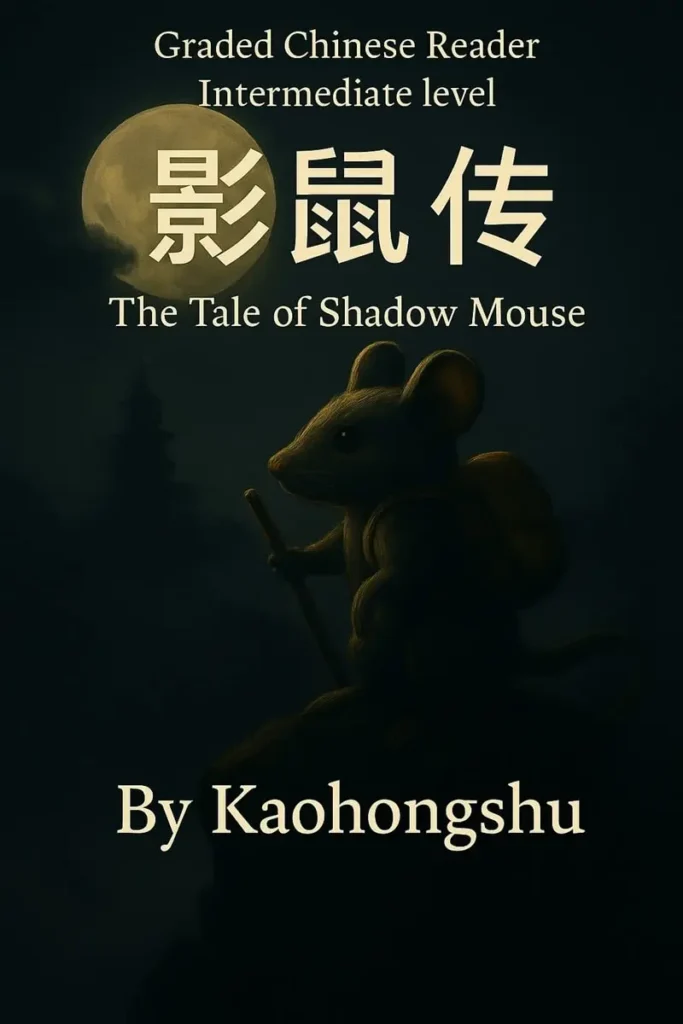
So whether you’re learning hanzi, exploring ancient myths, brushing up on grammar, or trying to understand modern Chinese politics, you’ll find recommendations across a range of topics, even my own graded reader Shadow Mouse. Each section highlights a few standout titles – accessible, insightful, and chosen with learners and curious readers in mind. Browse around, discover something new, and let these books bring you closer to the world of China.
Chinese characters
Chinese characters: fascinating but where to start? It is well known that the approach to learning hanzi used for children in China does not work particularly well for adults learning Chinese as a foreign language. After all, Chinese children already possess a rich vocabulary before they even learn to read and write. Furthermore, they are far more immersed in and surrounded by the Chinese language.
If you begin learning Chinese as an adult, you likely won’t have that advantage; fortunately, however, there are books available to help you navigate the world of Chinese characters. As a rule, these books focus on the most frequently used characters, omitting the less common vocabulary that Chinese children’s books are often filled with. You will learn about the so-called “radicals”, which convey a character’s meaning, and the phonetic components that indicate its pronunciation.
Which book is most suitable depends primarily on whether you wish to prioritize writing, reading or just deepen your understanding of Chinese characters. If writing is important to you, it is worth checking whether a companion workbook with writing exercises is available. In any case, make sure to verify that the method employed is truly what you are looking for.


Chinese Graded Reader: The Tale of Shadow Mouse

Deep beneath the city of Beijing, a small mouse named 小影 (Xiǎo Yǐng) lives a quiet life in the subway tunnels – until a government extermination campaign forces him to flee. Armed with nothing but a tourist’s map, an old MP3 player, and his courage, he sets out on a perilous journey to Kaifeng in search of his family.
Shadow Mouse is an original graded reader for (upper) intermediate Chinese learners (HSK 4–6). Written entirely in simplified Chinese and published by myself, it features over 1,000 unique characters, rich vocabulary, and a compelling storyline. The book includes extensive vocabulary lists, bonus materials, and downloadable audio.
No unnecessary pinyin that distracts and covers 40 % of the pages – just immersive reading that helps you build fluency while enjoying a real story.
Follow 小影 through metro tunnels, rain-soaked alleys, secret kitchens, and Shaolin mouse temples in this heartfelt tale of adventure, resilience, and the search for home.
Chinese grammar
Despite the persistent myth that modern Chinese lacks grammar, there are indeed plenty of books dedicated to the rules of the Chinese language. Some are more practical, staying close to “real-world communication,” while others are more academic – primarily comprehensive and descriptive in nature.
If you are serious about learning Chinese and are focused on the long term, owning a grammar reference book to serve as both a guide and a reference tool can certainly be advantageous. After all, a good grammar book organizes the material more systematically and covers a vast scope – typically encompassing most grammar points between HSK 1 and HSK 6. That’s why a good grammar book is invaluable whenever you feel unsure about a specific point or wish to delve deeper through additional examples and explanations. This is especially true given that there are currently no apps I know of capable of truly replacing a solid reference work for Chinese grammar.
These books can be quite expensive, so please do check their table of contents and a sample of the first pages to get a good impression if it is actually what you’re looking for. As for the Chinese Grammar Wiki, this is a resource that exists online as well and covers grammar points per language level with practical examples.


The Haunted Monastery by Robert van Gulik

This Judge Dee mystery by Robert van Gulik is set in Imperial China and features Judge Dee, a magistrate and statesman of the Tang court. Judge Dee and his entourage, seeking refuge from a mountain storm, become trapped in a Taoist monastery. The monks call it a supernatural experience, but the judge calls it murder. Recalling the allegedly accidental deaths of three young women in the same monastery, Judge Dee seeks clues in the eyes of a cat to solve cases of impersonation and murder. A painting by one of the victims reveals the truth about the killings, propelling the judge on a quest for justice and revenge.
Robert van Gulik (1910-1967) was a Dutch diplomat, sinologist, musician, and writer. He is best known for his Judge Dee historical mysteries, featuring Judge Dee, a protagonist borrowed from the 18th-century Chinese detective novel Dee Goong An. Van Gulik’s Judge Dee mysteries follow the long tradition of Chinese detective fiction, intentionally preserving a number of key elements of that writing culture. Most notably, Judge Dee solves three different (and sometimes unrelated) cases in each book, a traditional device in Chinese mysteries.
Chinese mythology
Chinese mythology may seem like an exotic subject, but it serves as an extremely interesting “lens” through which to view Chinese culture. This involves not only the primordial myths concerning the creation of the earth and the fashioning of the first humans from the yellow river clay, but also more modern tales, such as the world-famous Journey to the West, which explores the Chinese spiritual realm through a Buddhist perspective.


The Four Chinese Classics

“The Four Chinese Classics” by David Hinton offers a selection of key works from the rich tradition of Chinese philosophical and spiritual literature. It includes excerpts from the I Ching (Book of Changes), Tao Te Ching (by Lao Tzu), Chuang Tzu, and the Analects (of Confucius). Hinton’s approach emphasizes the poetic and mystical dimensions of these texts, making them accessible to a modern audience while retaining their profound wisdom and insight into the nature of reality, self, and the universe. It’s a valuable introduction to the foundational texts that have shaped Chinese culture and thought for millennia.
Chinese history
Is it possible to understand anything about China without engaging with its history? Of course not. Often, however, this is mainly a practical question. Who, for instance, has the time to read Jonathan D. Spence’s definitive work? And where to begin? The very first dynasty, or perhaps closer to the present, the Qing dynasty and the colonization of China? In any case, it is a fascinating subject, provided you have the time to delve into it.
A highly accessible introduction is offered by the lecture series “From Yao to Mao” by Ken Hammond; it manages to recount 5,000 years of Chinese history in an engaging and broad-strokes manner, without losing its way and ultimately bringing the narrative full circle to the China of Mao Zedong and Deng Xiaoping.


Chinese politics
Discussions regarding Chinese politics are – usually instinctively, or probably deliberately – avoided within the world of Chinese language education. There are simply too many tricky issues to risk getting burned by, ranging from Xinjiang to Taiwan. Yet that does not make the subject any less fascinating. It begins with questions such as: How does the Chinese political system actually function? How is power distributed between the political and economic spheres? And why, exactly, is such a capitalist nation still led by a Communist Party? If you wish to gain a deeper understanding of China, you simply cannot continue to ignore its political system indefinitely, although most language educators do.
Modern Chinese politics has been shaped by revolution, reform, and rapid transformation. This section explores key forces driving China’s political landscape since 1945, from the rise of the Chinese Communist Party to the social and economic tensions that continue to shape its future. One title offers a clear-eyed look at the Party’s structure, ideology, and enduring influence, while another examines the deepening urban-rural divide – a challenge that poses serious questions for China’s continued development.


HSK Standard Course

The HSK Standard Course is a series of textbooks designed to prepare learners for the Hanyu Shuiping Kaoshi (HSK), China’s official standardized test for Mandarin proficiency. Developed by Beijing Language and Culture University Press, the series covers HSK levels 1–6, with each level consisting of a textbook and a workbook. The course integrates vocabulary, grammar, listening, speaking, reading, and writing practice, following the official HSK syllabus. It is widely used in classrooms and self-study, offering structured lessons, exercises, and audio resources to help learners systematically improve their Chinese proficiency.
Graded readers
I know that not everyone is convinced by graded readers – or perhaps they like the concept but simply haven’t gotten around to trying them yet. Yet, virtually every serious learner of Chinese faces the same dilemma. Eventually, textbooks alone are no longer sufficient, while authentic reading material – such as novels, social media posts, or news articles – remains too difficult to read without frustration.
Graded readers fill precisely this gap; they are designed to hone your reading skills within an appropriate framework, neither too simplistic nor incredibly arduous.
Nowadays, there is a considerable selection available in the world of graded readers, though not every story or cover will necessarily appeal to you. One thing to look out for is the presence of Pinyin printed above the characters. While it is certainly convenient to be able to read the pronunciation immediately, you will find that your brain struggles to absorb the characters when letters are also present. The better graded readers therefore often come with a cover template that you can place over the text.
You should also check how much actual Chinese text a graded reader contains. It is quite common for readers to include Pinyin and English translations alongside the Chinese text. It may appear as though you are purchasing a substantial volume, but the actual Chinese reading material often accounts for less than a third of the book – which can be rather disappointing. For this reason, my own graded reader deliberately omits Pinyin sections and translations, allowing you to focus your attention entirely on the Chinese text.


Mandarin Chinese Picture Dictionary

The “Mandarin Chinese Picture Dictionary” is a visual learning tool designed to help beginners quickly grasp essential Mandarin vocabulary. It organizes words by topic, with colorful illustrations accompanying each entry. This makes it easy to associate words with their meanings, aiding memorization and pronunciation. It’s a handy resource for building a basic vocabulary and is particularly useful for visual learners. While it may not delve into complex grammar, it’s a great starting point for anyone looking to learn everyday Mandarin Chinese words in a fun and accessible way.
Happy reading!
I hope you’ve found a book – or a few – that spark your interest and support your journey into Chinese language and culture. Whether you’re just beginning or deepening your understanding, the right book can make all the difference. Thanks for visiting, enjoy the read and please return, as I’ll continue to improve the inventory of this page!